In Deanhaugh Street: the Edinburgh Photography of Robert Blomfield
June 1, 2026 James Hamilton
(The photographs accompanying this piece were taken at the University of Edinburgh’s 2022 Exhibition of Blomfield’s work, Student of Light. Blomfield’s work is superbly presented at the site created by his sons and in Stu Edwards’ marvellous films An Unseen Eye and Student of Light. There have also been six Café Royal books and the [now out of print] Bluecoat Press publication Robert Blomfield: Edinburgh 1957-1966.)
1.
Barely twenty years after the death of Francis Chrystal in an ancient Canongate poorhouse, another medic-photographer arrived in Edinburgh. Tie-less, soft-shoed and soon bearded, Robert Blomfield washes in from Sheffield as a student and with his black-painted Nikon F around his neck will be a local presence for much of the 1960s. Like Chrystal he is both a traveller of the world and a habitué of poorer parts of Edinburgh, adopting Stockbridge and Dumbiedykes as Chrystal had Fountainbridge before him.
 Legs and Pictures at the University of Edinburgh’s 2022 Exhibition “Robert Blomfield: Student of Light”
Coming onto Blomfield’s photography straight after Chrystal’s can be like waking from a long sleep. Here they are again, the streets of the working city, wound forward three or four or five decades, and although the vehicles are no longer horsedrawn the people still head across the frame with purpose and here still are the children. But there are more elderly people now – the children from Chrystal’s glass plate negatives perhaps, at the other end of their lives – and Blomfield’s children have shoes and better clothes. The light has changed: not to the buttery sunshine of 1960s California but nevertheless something both brighter and paler, overcast, the same skies that the Beatles chase around beneath in A Hard Day’s Night.
There’s a difference too in the way Blomfield comes at things: he’s looser, lighter, easier by far. Chrystal rarely engaged with the people in his photographs, and in the Fountainbridge sequences the groups stand indifferent of him or occasionally hostile. But here under a flat grey sky people laugh into Blomfield’s camera, the tension broken by warmth, humour, a joke linking him to the foundry labourer and the man standing outside the paper shop. Others have recovered themselves and pulled back into their dignity for the taking of the actual picture, but the connection made is clear. And then there are the children.
In Francis Chrystal’s pictures, the children were often shadowy creatures kept away in the back of the wynd by aproned women with tense faces, with their men standing their ground closer in. By contrast, Blomfield’s children barrel merrily about India Place and Deanhaugh Street like things released, the happy avatars of the photographer’s own easy energy. With Blomfield, there’s a sense in his pictures of children that he has kept something alive within himself – or been allowed to - something lost by or taken from the older generation, something perhaps to do with the 1960s or the receding of the war.
These are after all post-war pictures, for all that the Blomfield light falls on the adults in the same way as it does the children, like a lid has been lifted off. It’s easy to make that mean too much. They are pictures also of a city of residents, and the people in his photographs look at home, tied in with what’s around them. The only departure from this is the pictures of Speaker’s Corner at the foot of the Mound, but even here, you take no sense of being in the company of strangers. It’s the changes to Edinburgh since that gives this its tangible quality.
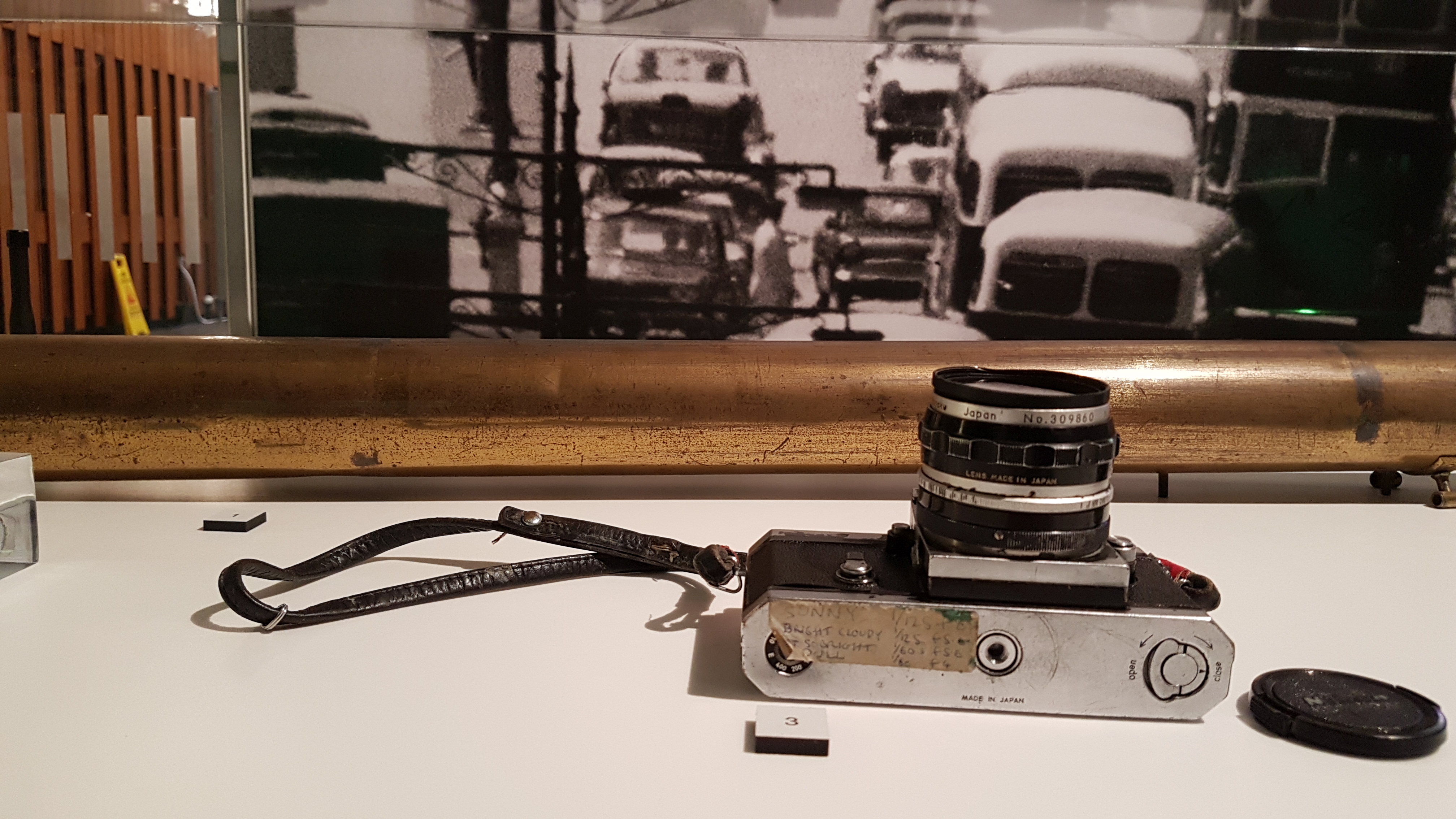 A Robert Blomfield camera at the University of Edinburgh 2022 Exhibition
Blomfield has anyway a photographer’s aesthetic that takes little specific interest in conventionally beautiful landscapes. His pictures rarely venture into the historic city centre, and then only to capture a particular effect of light or to attempt a novel framing. His telephoto images of the New Town and Princes Street are dramatic and entirely original. But they don’t flatter: they don’t agree that the conversation about a city should be about beauty and they feature – there is no getting around this - gridlocked traffic. This links to the fact that Blomfield’s best pictures aren’t of Edinburgh. The work from London and his own Sheffield outstrip them (his image of Western Bank Street competes with Winogrand’s World Fair as an epitome of the ‘60s).
2.
It’s something he shared with his contemporaries. The great Edwin Smith, in Edinburgh not long before Blomfield, was plainly bored by his commission for Youngson’s Classical Edinburgh and when Bill Brandt and Wolfgang Suschitzsky came through in the 1940s it was to seek out the smoky backs and to reprise framings they’d rehearsed more successfully elsewhere. Blomfield at least liked what he saw in Edinburgh, but although his Hamilton Place digs were yards from the supposed Embra set pieces like poor bullied Circus Lane he instead chose Greenside, Dumbiedykes and the slums of India Place.
It’s worth asking what his work might look like to non-British eyes. Blomfield has attracted comparision with the great humanist photographers of the generation before his, and he was known to be an admirer of Doisneau and Kertesz. But they were photographers of Paris, meaning that for British eyes their frames are replete with the strange and unknown. There are additional layers there that are missing when we look at Lartigue’s London pictures of the late 1920s, for instance, or when we compare Brassai’s great Paris de Nuit images with Brandt’s A Night in London. Blomfield’s pictures too we look at like natives.
It’s only now that those non-British eyes are getting the chance. Blomfield had a long and successful medical career and a happy married and home life. Photography was a pursuit, a love and not a profession, and it was only much later that his wife Jane, herself a photographer, began the task of organising his work and sending out feelers to galleries and the art world. Jane predeceased Robert and the job of bringing Blomfield’s photographs to the wider public has been taken on by his sons Ed, George and Will, and a great film maker, Stu Edwards.
 The second of Stu Edwards’ films about Blomfield showing at the 2022 University of Edinburgh exhibition
Robert lived to see his debut exhibition, Robert Blomfield: Edinburgh Street Photography - An Unseen Archive at Edinburgh’s City Art Centre in November 2018 (accompanied by the first of Stu Edwards’ fine films) and to experience its staggering success. His first book – Robert Blomfield: Edinburgh 1957-1966 – was brought out by Bluecoat Press in 2020 and included a section in which people who had identified themselves, friends or family in Blomfield images at the exhibition reflected on their lives and their meeting with him more than half a century earlier.
This was followed in the summer of 2022 by the exhibition Robert Blomfield: Student of Light, curated by Daryl Green of the University of Edinburgh and including Blomfield’s revelatory colour work of Edinburgh alongside a new Stu Edwards film and artifacts from Blomfield’s photographic life. Green and the University had brokered the taking on of the Blomfield archive from the family, providing it with a permanent home and access to conservation expertise whilst continuing the family’s relationship with their father’s work. Green’s exhibition was held in the University Library’s gallery, which was under construction during Blomfield’s time in the city and has been largely unaltered since, giving an unusually appropriate backdrop to the work.
 Curator Daryl Green opens the 2022 University of Edinburgh exhibition Robert Blomfield: Student of Light
Given that Scotland played such a disproportionately important part in early photography, it is striking that before Blomfield Edinburgh had failed to find or attract the equivalent of the photographers of New York or Paris. There was no Berenice Abbott for Edinburgh, no Lartigue, no Walker Evans or Robert Frank. Admittedly, Edinburgh had had its Eugene Salignac in the shape of Edwin Catford, and there have been photographers like Paul Shillabeer, the last at Rock House and the recorder of the early Festival. But Edinburgh is a centre of arts administration rather than of the arts, a market for the arts rather than a cradle. It’s history rather than art that is sui generis in Edinburgh, and it’s to the historians that the likes of Francis Chrystal were drawn and so to the work of record. Blomfield was, and remains, an outlier.
LINKS:
Robert Blomfield’s official site: https://www.robertblomfield.co.uk/
The Robert Blomfield Youtube Channel
Robert Blomfield’s work in Cafe Royal Books
Films by Stu Edwards:
Stu Edwards’ official site: https://www.stuartedwardsfilm.com/